PAY US SECURELY

Businesses today invest in online marketing to attract customers, generate leads, increase sales and build brand awareness. However, when companies start planning their marketing budgets, one question often comes up: Performance marketing vs digital marketing – which strategy should a business choose?
Both approaches help businesses reach potential customers online, but they work with different priorities, measurement methods and marketing objectives.
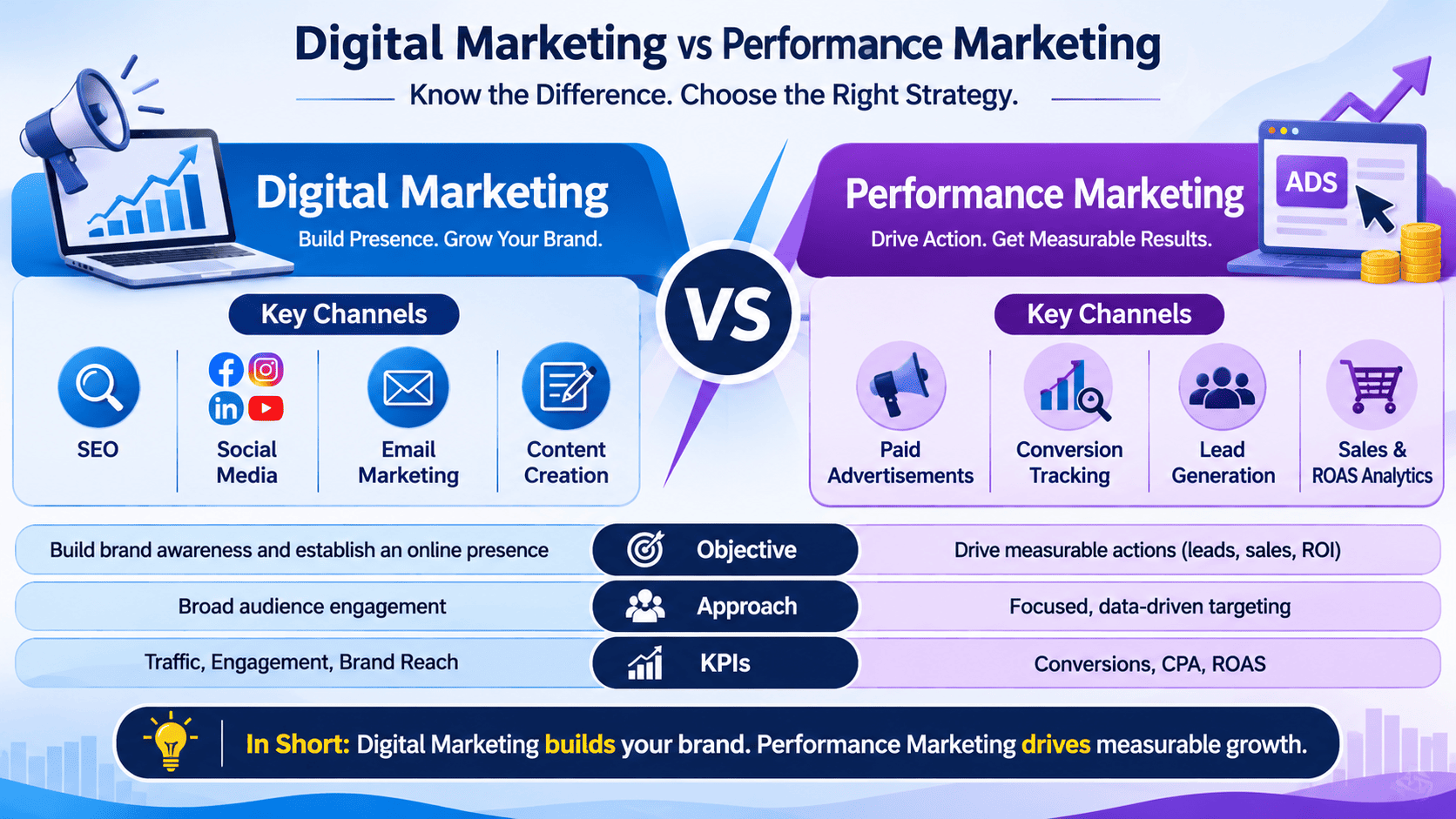
Digital marketing covers a broad range of online activities, including search engine optimisation (SEO), social media marketing, content marketing, email marketing, paid advertising and website optimisation. Performance marketing focuses more directly on measurable outcomes such as leads, purchases, app installations, registrations and customer acquisition.
The distinction matters when deciding where to invest your money. A business that wants to build long-term brand recognition may need a different marketing approach from a company that needs qualified leads within the next few weeks.
In this guide, we will explain performance marketing vs digital marketing, examine their differences, compare their channels and costs, and discuss how businesses can use both approaches to achieve better marketing results.
Digital marketing refers to the promotion of products, services and brands through digital channels. It allows businesses to connect with potential customers through search engines, websites, social media platforms, email, mobile applications and online advertising.
Unlike traditional marketing methods such as newspaper advertisements, billboards and television commercials, digital marketing gives businesses several ways to reach specific audiences and measure their online activity.
For example, a web development company in Kolkata might use SEO to appear in Google search results, publish educational articles to attract website visitors, share project updates on LinkedIn and run Google Ads to generate enquiries.
All these activities fall under digital marketing.
1. Search Engine Optimisation (SEO)
SEO improves a website's visibility in organic search results. It involves keyword research, technical optimisation, content development, internal linking and improving website experience.
For example, a company targeting the keyword "best website development company in Kolkata" can publish relevant service pages and useful articles to attract potential customers searching for web development services.
SEO usually requires consistent effort. Rankings and organic traffic may take time to develop, but well-maintained pages can continue generating relevant visitors without paying for every click.
2. Social Media Marketing
Social media marketing involves promoting a business through platforms such as Facebook, Instagram, LinkedIn and YouTube.
Businesses use social media to publish content, communicate with customers, build communities, promote products and maintain brand visibility.
A clothing brand, for example, can use Instagram Reels to introduce new collections, share customer photographs and encourage people to visit its online store.
3. Content Marketing
Content marketing focuses on creating useful information that helps potential customers understand a product, service or industry.
Common content formats include:
Blog articles and educational guides
Videos and short-form Reels
Case studies and customer stories
Industry reports and downloadable resources
Good content can support SEO, social media marketing, lead generation and customer education at the same time.
4. Email Marketing
Email marketing allows businesses to communicate directly with subscribers and existing customers.
Companies use email newsletters, promotional campaigns, welcome sequences, product updates and abandoned-cart reminders to maintain customer relationships and encourage repeat purchases.
5. Paid Digital Advertising
Paid advertising includes campaigns on Google Ads, Meta Ads, LinkedIn Ads, YouTube and other advertising networks.
Businesses can target audiences according to factors such as search intent, interests, location, demographics and previous interactions, depending on the platform and available settings.
Paid advertising can generate visibility quickly, although its effectiveness depends on campaign strategy, audience selection, creative quality and conversion tracking.
Performance marketing is an outcome-focused approach to digital advertising in which campaign success is evaluated using measurable business actions.
These actions may include:
Generating qualified leads
Receiving product purchases
Increasing app installations
Getting appointment bookings
Collecting registrations
Generating revenue
The central idea is to measure marketing activity against a defined objective rather than judging success only by impressions, clicks or website traffic.
For example, imagine an online furniture store invests ₹50,000 in advertising. The campaign generates 1,000 website visitors and 50 completed purchases.
If the business generates ₹2,00,000 in revenue from those purchases, the marketing team can examine the campaign's cost, revenue, conversion rate and return on advertising spend.
This information helps the business understand whether its advertising investment is producing commercially useful results.
Performance marketing generally follows a structured process.
1. Define the Business Objective
The first step is deciding what the business wants to achieve. A campaign designed to generate enquiries will require different settings and measurement from one designed to increase online purchases.
For example, a real estate company may prioritise qualified property enquiries, while an e-commerce business may focus on completed transactions.
2. Identify the Target Audience
The marketing team studies potential customers, their interests, online behaviour, purchasing needs and search intent.
Audience selection should be connected to the product or service being promoted. Reaching a large audience is not automatically beneficial if most people have no interest in purchasing.
3. Select the Right Advertising Channels
Depending on the objective, businesses may use Google Search Ads, Google Shopping, Meta Ads, YouTube Ads, affiliate campaigns or other suitable platforms.
The channel should match how potential customers discover and evaluate the product.
4. Create Campaigns and Landing Pages
Performance marketing requires relevant advertisements and a clear conversion path.
An advertisement promising a consultation should direct visitors to a page where they can understand the service and request a consultation. Sending all visitors to an unrelated homepage can reduce conversion opportunities.
5. Track Conversions and Analyse Results
Tracking helps businesses understand which campaigns generate valuable actions.
Marketing teams may measure cost per lead, cost per acquisition, conversion rate, revenue and return on advertising spend.
6. Optimise Campaigns
The team reviews results and makes changes to targeting, bidding, advertising creative, landing pages and budget allocation.
For example, if one campaign generates many enquiries but very few qualified prospects, the issue may involve audience targeting, the offer or the lead qualification process.
Performance marketing is therefore an ongoing cycle of testing, measurement and improvement.
Although performance marketing and digital marketing use many of the same online channels, their priorities can be different.
The following comparison explains the main differences.
| Comparison Factor | Digital Marketing | Performance Marketing |
|---|---|---|
| Meaning | Broad online marketing approach | Outcome-focused marketing approach |
| Main objective | Brand awareness, engagement, traffic, leads and sales | Measurable leads, conversions, purchases and revenue |
| Focus | Overall online presence and customer journey | Campaign performance and business outcomes |
| Channels | SEO, social media, email, content and paid ads | Google Ads, Meta Ads, affiliate marketing and other measurable campaigns |
| Measurement | Organic traffic, engagement, rankings, leads and conversions | CPA, CPL, ROAS, conversion rate and revenue |
| Time horizon | Often medium to long term, depending on channel | Often focused on campaign-level and short-to-medium-term results |
| Budget approach | Can include organic investment and paid media | Often involves campaign budgets tied to measurable objectives |
| Optimisation | Improves overall digital presence and customer experience | Uses conversion data and experiments to improve outcomes |
| Best suited for | Building online visibility and developing customer relationships | Driving and measuring specific business actions |
The biggest difference between digital marketing and performance marketing is the way business objectives are prioritised.
Digital marketing supports several goals. A company may want to increase brand awareness, improve organic search visibility, grow social media engagement or educate potential customers.
Performance marketing usually starts with a defined action that the campaign should generate.
For example:
Digital marketing objective: Increase awareness of a new skincare brand among potential customers.
Performance marketing objective: Generate 500 purchases from a defined advertising budget.
Both objectives can be valuable. A business needs to decide which outcome matters most at a particular stage of growth.
Digital marketing includes almost every major online promotional activity.
SEO, website development, content marketing, email campaigns, organic social media and paid advertising all contribute to a business's digital marketing strategy.
Performance marketing typically relies on channels and campaigns where actions can be tracked and evaluated.
Common examples include:
Facebook and Instagram advertising
YouTube advertising
Affiliate marketing
Cost-per-action campaigns
App-install campaigns
One important point is that these channels are not exclusive to performance marketing.
For example, Meta Ads can be used for brand awareness campaigns as part of a wider digital marketing strategy or configured to pursue purchases and leads as a performance marketing campaign.
The campaign objective and measurement approach determine its role.
Another common question is whether performance marketing is cheaper than digital marketing.
Digital marketing can involve organic activities such as SEO and content development, as well as paid activities such as search advertising and sponsored social media campaigns.
Performance marketing is often associated with payment models such as:
CPC (Cost Per Click)
CPM (Cost Per Thousand Impressions)
CPL (Cost Per Lead)
CPA (Cost Per Acquisition or Action)
Revenue sharing or affiliate commission
However, performance marketing does not always mean that advertisers pay only when a sale happens. Many campaigns still use CPC or CPM buying models while optimising for a conversion objective.
The more important factor is whether the campaign is measured against a meaningful business result.
Businesses should consider advertising spend, agency fees, creative production, landing page costs, technology and the internal resources needed to manage campaigns.
Digital marketing and performance marketing use several overlapping metrics, but they do not always interpret success in the same way.
Digital marketing may measure:
Organic website traffic
Keyword rankings
Social media reach
Engagement rate
Email open and click rates
Website enquiries
Performance marketing generally gives more attention to:
CPL (Cost Per Lead)
CPA (Cost Per Acquisition)
CAC (Customer Acquisition Cost)
CTR (Click-Through Rate)
CVR (Conversion Rate)
ROAS (Return on Ad Spend)
Revenue generated
Consider a campaign that receives 10,000 clicks but generates only five purchases.
Looking at traffic alone could make the campaign appear successful. Looking at sales, acquisition costs and revenue may reveal a different result.
This is why selecting the right KPI before launching a campaign is important.
Digital marketing activities have different timeframes.
An SEO campaign usually requires consistent work before meaningful organic visibility develops. Content marketing and social media activities also need time to establish reach and customer trust.
Paid performance campaigns may start generating clicks and conversions soon after launch, provided the offer, audience, tracking and campaign setup are appropriate.
However, quick campaign launches should not be confused with guaranteed profitability.
A business may receive enquiries immediately but still need time to assess lead quality, sales conversion rates and customer value.
The actual timeframe depends on the channel, industry, competition, budget and buying cycle.
Digital marketing involves managing the complete online presence of a business.
This includes ensuring the website communicates the right message, content answers customer questions, search visibility improves and social channels remain useful and relevant.
Performance marketing focuses more heavily on campaign-level improvement.
For example, a team may test two advertising creatives, compare audience segments, review search terms and improve a landing page to reduce cost per qualified lead.
The two approaches become more effective when they share information. Organic search queries can inform paid keyword selection, while paid campaign data can reveal which offers and customer segments deserve more content development.
Understanding the difference becomes easier when we look at practical business situations.
Imagine a digital marketing agency in Kolkata that offers website development, SEO and social media management.
Its wider digital marketing strategy might include:
Publishing SEO-focused service pages.
Creating blog articles about website development.
Sharing project work on social media.
Maintaining its Google Business Profile.
Sending useful updates to existing clients.
These activities improve online visibility and help potential customers discover the company.
Its performance marketing campaign might focus on generating qualified enquiries through Google Search Ads.
The team could target relevant search terms, direct visitors to a dedicated service landing page and measure completed enquiry forms or calls.
In this situation, digital marketing builds the company's overall online presence, while performance marketing helps generate and evaluate specific acquisition outcomes.
Consider an online clothing store launching a new seasonal collection.
Its digital marketing activities may include publishing product guides, sharing styling videos, improving product descriptions, creating email newsletters and building organic visibility.
Its performance marketing campaigns may promote specific products through Meta Ads and Google Shopping.
The marketing team can track purchases, revenue, average order value and advertising spend to understand campaign profitability.
A campaign that produces sales at a high acquisition cost may require changes even when its revenue looks impressive.
An educational institute wants to increase student admissions for its upcoming academic session.
Its digital marketing plan may include course information pages, educational blog content, faculty videos, student testimonials and social media updates.
Its performance marketing campaign may promote admission enquiries through Google Ads and Facebook Ads.
The institute should measure more than the number of submitted forms. It should also examine how many enquiries meet admission requirements, attend counselling sessions and complete registrations.
This example demonstrates an important principle: a low cost per lead does not automatically mean a successful campaign.
There is no single answer for every business.
The right approach depends on your business goals, target audience, competition, sales process and available marketing budget.
Digital marketing is a suitable priority when your business wants to:
Build brand awareness in a competitive market.
Improve organic search rankings.
Develop a consistent social media presence.
Educate customers about products and services.
Build trust through useful content and customer communication.
Develop long-term sources of website traffic and enquiries.
For a newly established business, these activities can help create the foundation required for sustainable online growth.
Performance marketing may be a suitable priority when your business wants to:
Generate leads within a defined campaign period.
Increase e-commerce sales.
Promote a new product or service.
Acquire customers through paid advertising.
Measure advertising costs against conversions.
Test different offers, audiences and landing pages.
It is particularly useful when the business has a clear offer, a functioning conversion process and enough data to evaluate results.
In many cases, using both approaches is the most practical decision.
Digital marketing establishes the wider online presence of a business. Performance marketing can help accelerate specific acquisition goals and provide measurable campaign data.
For example, a company can use SEO and content marketing to attract organic visitors while running paid search campaigns to reach people actively looking for its services.
The company can also use social media content to build familiarity and retarget suitable website visitors through advertising, where permitted by platform settings and applicable privacy requirements.
Rather than treating these approaches as competitors, businesses should connect them within a common marketing plan.
A performance marketing campaign should be evaluated using metrics that relate to its business objective.
Here are some of the most useful measurements.
CPL measures how much advertising spend is required to generate one lead.
Formula:
CPL = Total Advertising Spend ÷ Number of Leads
For example, if a company spends ₹20,000 and receives 100 leads:
CPL = ₹20,000 ÷ 100 = ₹200
The result is an average advertising cost of ₹200 per lead.
It is important to compare CPL with lead quality and the percentage of leads that become customers.
CPA measures the cost of acquiring a completed conversion, such as a purchase or a defined customer acquisition event.
Formula:
CPA = Total Campaign Cost ÷ Number of Acquisitions
For example, if a business spends ₹30,000 to acquire 30 customers, its CPA is ₹1,000.
A business should define exactly what counts as an acquisition before comparing campaigns.
ROAS compares revenue attributed to advertising with advertising expenditure.
Formula:
ROAS = Revenue Attributed to Ads ÷ Advertising Spend
For example, if an advertisement generates ₹1,50,000 in attributed revenue from ₹30,000 in ad spend:
ROAS = 5
This means the campaign generated ₹5 in attributed revenue for every ₹1 spent on advertising.
ROAS is not the same as profit. It does not automatically account for product costs, shipping, taxes, returns, salaries or other operating expenses.
Conversion rate measures the percentage of visitors or users who complete a desired action.
Formula:
Conversion Rate = (Number of Conversions ÷ Number of Visitors) × 100
If 1,000 people visit a landing page and 50 submit an enquiry form, the conversion rate is 5%.
Improving the page experience, offer, messaging and form design may help increase this figure.
CAC measures the cost of acquiring a new customer across relevant sales and marketing expenses.
A business may calculate CAC using advertising, agency fees, sales expenses and other acquisition costs.
This broader measurement is useful because advertising-platform CPA alone may not reflect the complete cost of acquiring a customer.
Even a well-funded campaign can produce weak results when the underlying strategy is incorrect.
Based on practical campaign management principles, these are some mistakes businesses should watch for.
A high number of clicks does not guarantee leads or sales.
Businesses should evaluate what visitors do after reaching the website. If the campaign generates traffic but few conversions, review the search intent, advertising message, landing page and offer.
An advertisement can attract the right audience, but a confusing landing page can prevent visitors from taking action.
The page should explain the service, communicate its benefits, provide relevant information and make the next step clear.
A website button click is not necessarily a qualified lead. Similarly, a form submission may not represent a completed sale.
Businesses should distinguish between primary conversions and supporting actions, then ensure that important events are recorded correctly.
Changing campaign settings every day without enough reliable data can make performance difficult to evaluate.
Allow campaigns an appropriate testing period, review meaningful conversion data and make changes based on evidence rather than assumptions.
Generating 500 enquiries is not necessarily better than generating 100 relevant enquiries.
Sales teams should share feedback with marketing teams so that campaigns can be optimised for qualified prospects and actual business results.
A high ROAS can still be unprofitable when product margins and operating costs are high.
Always examine advertising returns alongside gross margin, customer acquisition cost and contribution to profit.
Businesses do not need separate and disconnected strategies for digital marketing and performance marketing.
A well-planned approach can connect long-term brand development with measurable customer acquisition.
Here is a practical framework.
Step 1: Understand Your Target Customers
Identify who is most likely to purchase your product or service. Understand their requirements, common problems, purchasing behaviour and the information they need before making a decision.
Step 2: Set Clear Marketing Goals
Define specific goals such as increasing organic traffic, receiving qualified enquiries, generating online purchases or improving customer retention.
Avoid choosing multiple KPIs without identifying which business outcome matters most.
Step 3: Select Suitable Marketing Channels
Choose channels according to customer behaviour.
SEO may work well for customers who actively search for solutions. Social media can help brands reach and educate relevant audiences. Paid search may be suitable for capturing existing demand.
Step 4: Build a Strong Website and Landing Pages
Your website should load properly, work on mobile devices and explain your services clearly.
Every important landing page should provide relevant information and a straightforward conversion path.
Step 5: Implement Conversion Tracking
Set up appropriate analytics and advertising measurement before launching campaigns.
Google Analytics 4 provides attribution reporting that helps businesses understand how different marketing touchpoints contribute to key events. Its data-driven attribution model uses account data to distribute conversion credit across interactions, rather than simply assigning all credit to the final interaction. The available reporting options depend on the property and channel setup.
Step 6: Analyse Results and Improve
Review campaign costs, conversion quality, customer acquisition and revenue.
Use these findings to improve advertising, content, landing pages and future budget decisions.
Step 7: Connect Marketing and Sales Data
A campaign should ultimately contribute to business performance.
Where possible, connect lead records and sales outcomes to marketing reports. This helps identify which channels generate customers rather than just enquiries.
Choosing a marketing agency is another important decision for growing businesses.
Before hiring an agency, understand the type of support your business actually requires.
If your primary goal is to establish a stronger online presence, you may need a digital marketing agency with experience in SEO, content marketing, social media, website development and brand communication.
If your goal is to generate measurable leads and sales through paid campaigns, look for a team with experience in campaign strategy, advertising platforms, conversion tracking, landing page optimisation and performance reporting.
Ask potential agencies the following questions:
How do you understand our business and target customers?
Which channels would you recommend, and why?
What metrics will you use to evaluate success?
How will you track qualified leads and completed sales?
How frequently will you share campaign reports?
How do you handle underperforming campaigns?
Will we have access to advertising accounts and campaign data?
Do not select an agency based only on promises of guaranteed rankings, a fixed number of leads or unusually low advertising costs.
A capable marketing partner should explain its strategy, measurement process, limitations and expected business outcomes clearly.
The comparison between performance marketing vs digital marketing becomes easier when you understand their different roles.
Digital marketing is the broader strategy businesses use to build online visibility, reach customers, communicate value and establish a lasting digital presence.
Performance marketing is an outcome-focused approach that places greater emphasis on measurable actions such as leads, purchases, registrations and customer acquisition.
Both approaches have a place in a modern marketing strategy.
A company that wants long-term organic visibility should invest in SEO, content and brand development. A company that needs to generate measurable enquiries or sales may benefit from performance-focused advertising. Businesses with broader growth targets can combine both approaches and evaluate them using meaningful business metrics.
The best marketing decision is the one that connects your budget, customer needs and business objectives with measurable results.
If your business is planning to improve its online presence or generate more qualified enquiries, choose a marketing strategy based on your actual growth requirements rather than following a trend.
Digital marketing is a broad term covering online promotional activities such as SEO, content marketing, social media, email marketing and paid advertising. Performance marketing focuses on measurable outcomes such as leads, purchases, registrations and customer acquisition. Performance marketing is generally considered a specialised part of digital marketing.
Yes. Performance marketing is generally considered a specialised approach within digital marketing. It uses digital advertising channels and measurable campaign objectives to generate and evaluate specific business actions.
Neither is universally better. Digital marketing is suitable for improving online visibility, brand awareness, organic traffic and customer relationships. Performance marketing is useful when a business wants to measure leads, conversions, sales and advertising returns. The right choice depends on the company's objectives.
SEO is generally classified as a digital marketing activity. However, SEO campaigns can also be managed using a performance-focused approach by measuring organic leads, sales, conversion rates and revenue generated from search traffic.
Google Ads can be used as a performance marketing channel when campaigns focus on measurable outcomes such as purchases, leads, calls or registrations. It can also be used for objectives such as brand awareness and website traffic.
Common performance marketing KPIs include cost per lead (CPL), cost per acquisition (CPA), customer acquisition cost (CAC), click-through rate (CTR), conversion rate (CVR) and return on ad spend (ROAS). The correct KPIs depend on the campaign objective.
Yes. Small businesses can use performance marketing to promote local services, generate enquiries and reach relevant audiences through paid advertising. They should begin with a realistic budget, clear conversion goals and reliable tracking.
Yes. SEO, content marketing, organic social media, email marketing and referral activity can generate leads and sales without paying for every visitor or conversion. However, these activities still require time, expertise and resources.
ROAS measures the revenue attributed to advertising compared with advertising spend. ROI evaluates the return from an investment against its cost and can account for broader business expenses. A campaign with strong ROAS is not automatically profitable.
Yes. Businesses can combine SEO, social media, content marketing and email campaigns with performance-focused advertising. This allows them to build long-term online visibility while pursuing measurable customer acquisition goals.
There is no fixed budget for every business. The required investment depends on industry competition, target audience, average customer value, advertising costs and conversion rates. Businesses should start with a test budget they can afford and increase spending when reliable results support it.
Paid campaigns can begin generating clicks and conversions soon after launch, but meaningful performance evaluation requires sufficient conversion data. The time needed to assess profitability depends on campaign volume, sales cycles, tracking quality and customer purchasing behaviour.

Meta Ads Performance Marketing: Strategy, Leads & ROI
Date : 06 Nov, 2026
Performance Marketing vs Digital Marketing: Key Differences
Date : 04 Nov, 2026
Performance Marketing Agency Near Me | Grow Your Business
Date : 02 Nov, 2026
How Performance Marketing Helps Small Businesses Grow Fast
Date : 31 Oct, 2026
Best performance marketing agency in Kolkata
Date : 27 Oct, 2026
Performance Marketing Agency in Kolkata | Digital Seeds
Date : 26 Oct, 2026