PAY US SECURELY


In today's competitive digital marketplace, simply running advertisements on Google, Facebook, or Instagram is not enough to grow a business. You need a strategy that connects your advertising budget to measurable business outcomes, such as qualified leads, product sales, appointments, enquiries, and revenue.
This is where a professional performance marketing agency in Kolkata can make a difference.
Whether you operate a local service business in South Kolkata, an educational institute in Salt Lake, a healthcare organisation in New Town, an e-commerce store serving customers across India, or a B2B company targeting decision-makers, performance marketing helps you reach relevant audiences and measure what your campaigns achieve.
Unlike marketing approaches that focus mainly on visibility and engagement, performance marketing connects advertising activities with specific, measurable objectives. The goal is not simply to generate clicks. It is to understand which clicks become customers, which campaigns produce profitable results, and where your marketing budget can work harder.
At APURBO Digital, the performance-focused approach combines paid advertising, audience research, creative development, landing-page optimisation, and conversion tracking to help businesses make more informed marketing decisions.
In this guide, we explain how performance marketing works, which services matter most, how to evaluate campaign results, and what Kolkata businesses should consider before investing in digital advertising.
Performance marketing is a results-focused digital marketing approach in which advertising campaigns are planned, measured, and optimised against defined business objectives.
These objectives can include:
Generating qualified enquiries and sales leads.
Increasing online purchases and e-commerce revenue.
Driving appointment bookings and consultation requests.
Increasing phone calls and WhatsApp enquiries.
Acquiring customers at a sustainable cost.
For example, suppose a Kolkata-based interior design company wants to generate enquiries from homeowners planning renovations. Instead of advertising to a broad audience without a clear objective, a performance marketing strategy could use relevant Google Search keywords, geographically appropriate targeting, persuasive ad copy, and a landing page designed to encourage consultation bookings.
The campaign would then be evaluated using enquiry volume, lead quality, cost per qualified lead, and the number of enquiries that become paying customers.
This approach helps businesses move beyond assumptions and make decisions using measurable information.
However, performance marketing does not guarantee a particular number of leads or a fixed return. Results depend on factors such as competition, pricing, audience demand, campaign setup, advertising budget, website experience, and the effectiveness of the sales process.
Kolkata has a diverse business market that includes local service providers, healthcare organisations, educational institutions, tourism businesses, retail brands, manufacturers, and technology companies.
Each business has a different target audience and customer journey. A strategy that works for an online clothing store may not be suitable for a hospital, real estate developer, or B2B software company.
Working with a performance marketing agency in Kolkata can help your business build campaigns around its location, customer behaviour, and commercial objectives.
Effective advertising begins with understanding who is most likely to purchase your product or service.
Depending on your business model, targeting may involve location, search intent, demographic eligibility, relevant interests, website activity, or previous customer interactions, subject to platform policies and available targeting options.
For a local business, this could mean reaching potential customers in areas such as Behala, Tollygunge, Garia, Salt Lake, New Town, or other suitable Kolkata neighbourhoods.
For a company serving the wider Indian market, the strategy may involve targeting multiple cities, states, or customer segments.
The important principle is to reach relevant customers instead of paying for unnecessary exposure.
A campaign can generate thousands of impressions and still fail to produce meaningful business results.
A performance-focused agency examines where the budget is going, which audiences respond, what advertisements attract qualified prospects, and which campaigns contribute to revenue.
This process allows campaign decisions to be based on evidence rather than assumptions.
Businesses need to know what they are receiving in exchange for their advertising investment.
With appropriate tracking, you can measure enquiries, purchases, phone calls, appointment requests, and other meaningful customer actions.
Google Ads supports conversion measurement for actions such as website purchases, sign-ups, and calls. Businesses can also connect suitable offline conversion information to advertising platforms to evaluate outcomes beyond the initial website interaction.
Reference: Google Ads conversion tracking.
Launching an advertisement is only the beginning.
Performance marketing requires regular analysis of search terms, audience response, creative fatigue, conversion rates, landing-page behaviour, lead quality, and the actual cost of acquiring customers.
This ongoing optimisation helps identify opportunities to improve campaign efficiency as sufficient data becomes available.
A complete performance marketing strategy involves more than creating advertisements. It connects audience research, campaign execution, measurement, and sales outcomes.
Google Ads can help businesses reach potential customers when they actively search for products or services.
For example, someone searching for a website development company in Kolkata may already have a specific requirement. A well-structured search campaign can connect that search intent with a relevant advertisement and landing page.
Google Ads services may include:
Display and remarketing campaigns where appropriate.
Shopping and Performance Max campaigns for suitable businesses.
Keyword research and search-term analysis.
Negative keyword management.
Ad copy and asset testing.
Conversion tracking and budget optimisation.
The right campaign structure depends on the business objective, available data, competition, and customer journey.
Facebook and Instagram advertising can help businesses introduce their products, generate enquiries, remarket to interested users, and encourage purchases.
Meta Ads can be particularly useful when creative presentation, audience discovery, social proof, or repeated exposure plays an important role in customer decisions.
Services may include:
Lead generation campaigns.
Website conversion campaigns.
E-commerce sales campaigns.
Creative testing and audience testing.
Remarketing to eligible audiences.
Campaign reporting and performance analysis.
A common mistake is to judge Meta Ads only by the number of leads generated. A more useful evaluation examines whether those leads answer calls, meet the business's requirements, attend appointments, and eventually purchase.
Lead generation is an important application of performance marketing, particularly for businesses that sell services or require a consultation before purchase.
These businesses may include educational institutes, real estate companies, healthcare providers, travel agencies, professional service firms, and B2B organisations.
A strong lead generation campaign should define:
Who qualifies as a potential customer.
What problem the advertisement addresses.
Why the prospect should enquire.
Which information needs to be collected.
How quickly the sales team will follow up.
How lead quality and conversions will be recorded.
The objective is not to collect the highest possible number of form submissions. It is to generate enquiries that have a realistic chance of becoming customers.
Sending paid traffic to a website is not enough if visitors cannot easily understand the offer or take the next step.
Landing-page optimisation focuses on reducing friction between the advertisement and the desired action.
A landing page should normally include a clear headline, relevant information about the offering, appropriate trust signals, a visible call to action, mobile-friendly design, and an easy enquiry process.
For example, a user who clicks an advertisement for an affordable website development service should arrive on a page that explains the service, outlines the next step, and makes contacting the business straightforward.
Without accurate tracking, it is difficult to determine which campaigns are producing business value.
Depending on your website and campaign setup, measurement may use Google Ads conversion tracking, Google Analytics 4, Google Tag Manager, the Meta Pixel, and Meta Conversions API.
These tools should be configured carefully, with appropriate consent and privacy safeguards.
Meta provides guidance on using the Pixel and Conversions API to improve event measurement and campaign optimisation. See Meta's Conversions API learning resources.
Tracking should distinguish meaningful events, such as a completed purchase or qualified enquiry, from low-value interactions that do not necessarily represent business growth.
A successful campaign starts with the right process, not merely an advertisement.
Before spending money, establish what the business wants to achieve.
Are you trying to generate enquiries, sell products online, book consultations, increase store visits, or acquire long-term B2B clients?
The answer influences the advertising channel, messaging, targeting, budget allocation, and conversion tracking.
For example, a business that depends on phone enquiries may need call tracking and a reliable follow-up process. An e-commerce store may need purchase-value tracking and product-level reporting.
Audience research helps identify customer needs, buying motivations, common objections, and the reasons prospects may choose one provider over another.
Competitor research can reveal differences in positioning, offers, messaging, and search visibility. It should inform your strategy rather than encourage copying another company's advertisements.
For local businesses in Kolkata, language, neighbourhood relevance, customer expectations, and service availability can also influence campaign messaging.
Different customer groups may have different levels of awareness and purchase intent.
Someone actively searching for a service may be ready to contact a provider. A person browsing social media may need more information before making a decision.
The campaign structure should reflect those differences, with suitable advertisements, landing pages, and conversion objectives.
Separating campaigns by meaningful business goals also makes it easier to understand performance and identify what needs improvement.
The advertisement must quickly communicate why the offer is relevant.
A useful creative generally focuses on a customer problem, a specific benefit, a reason to trust the business, and a clear next step.
For example, a website development advertisement might focus on helping businesses present their services professionally and encourage enquiries. A healthcare campaign must prioritise accurate, responsible communication and comply with applicable advertising policies.
Creative testing should compare meaningful variations, such as different value propositions, formats, headlines, or calls to action, while avoiding unnecessary changes that make results difficult to interpret.
Before scaling advertising expenditure, verify that the important conversion events are being recorded correctly.
A submitted form, an actual phone call, a confirmed appointment, and a completed purchase are different outcomes.
Where appropriate, connecting CRM or sales information with marketing reports can help establish which advertising campaigns generate valuable customers rather than just initial enquiries.
Tracking implementation must also respect user privacy, consent requirements, and platform policies.
Consider a hypothetical Kolkata-based service company receiving 100 leads in a month.
If most leads are irrelevant or unreachable, the headline lead figure may create a misleading impression of success. Another campaign producing fewer enquiries could deliver more qualified prospects and more paying customers.
A practical optimisation process investigates lead sources, search intent, form questions, sales follow-up, creative messaging, and conversion data before deciding what to change.
The lesson is simple: campaign performance should be assessed against business outcomes, not just platform metrics.
When a campaign demonstrates consistent results, the next step may involve expanding suitable audiences, testing new creatives, increasing budget gradually, or exploring additional advertising channels.
Scaling too quickly can make costs less predictable or overwhelm the sales team. The right approach depends on the strength of the data, operational capacity, conversion economics, and current market conditions.
Performance marketing can support many business models, but the right campaign objective differs across industries.
Clinics and healthcare organisations may use suitable advertising campaigns to encourage appointment enquiries and help potential patients discover relevant services.
Campaigns must be responsible, accurate, sensitive to patient privacy, and compliant with applicable healthcare advertising policies.
Schools, colleges, coaching centres, and professional training institutes may use lead generation campaigns to promote courses and collect admission enquiries.
Lead qualification, course relevance, follow-up speed, and admission conversion rates are important indicators of campaign quality.
Real estate businesses and interior designers may target audiences based on relevant locations, project details, and customer requirements.
Because these services can involve longer decision-making periods, tracking consultation bookings, qualified prospects, site visits, and sales progression is especially valuable.
Online sellers can use paid advertising to promote products and encourage purchases.
Revenue tracking, product margins, average order value, returns, and customer acquisition costs help businesses determine whether campaigns are financially sustainable.
Travel agencies, tour operators, hotels, and homestays can use advertising to promote packages, generate booking enquiries, and reach relevant travellers.
Seasonality, destination demand, booking windows, and enquiry-to-booking conversion rates should all influence campaign planning.
B2B businesses often need campaigns that focus on decision-makers and qualified opportunities rather than high volumes of low-intent leads.
Tracking sales-qualified leads, meetings, proposals, pipeline value, and closed deals can provide a more useful view of marketing contribution.
An experienced performance marketing partner should explain what campaign numbers mean for your business.
| Metric | What it tells you |
|---|---|
| Cost per lead (CPL) | Average advertising cost per recorded lead. |
| Conversion rate | Percentage of relevant interactions or visitors completing a defined action. |
| Cost per acquisition (CPA) | Average cost of acquiring a defined conversion or customer, depending on the measurement setup. |
| Return on ad spend (ROAS) | Tracked revenue attributed to advertising divided by advertising spend. |
| Customer acquisition cost (CAC) | Cost of acquiring a customer, ideally accounting for relevant marketing and sales costs. |
| Lead-to-customer rate | Percentage of leads that become paying customers. |
| Average order value (AOV) | Average revenue per order for an e-commerce business. |
These metrics should be interpreted together.
For example, a low cost per lead is not automatically a positive result if the leads rarely convert. Similarly, a high ROAS shown in an advertising dashboard needs context, because attributed revenue does not automatically equal profit.
Actual profitability depends on product or service margins, fulfilment costs, sales expenses, refunds, and other business costs.
A transparent report should separate advertising-platform results from verified business outcomes wherever possible.
A campaign should have a defined purpose and an appropriate conversion event. Otherwise, optimisation may focus on actions that do not support the commercial goal.
Broad targeting is not automatically wrong, but it must suit the campaign objective and available data. Poorly considered geographic or audience settings can waste budget.
Even relevant advertisements can underperform when the website loads slowly, the offer is unclear, or the enquiry process is difficult.
Clicks and impressions are useful diagnostic metrics, but they do not prove that a campaign generated customers or profitable sales.
The marketing campaign is only one part of the customer journey. Slow responses, missed calls, poor sales communication, and inconsistent follow-up can reduce conversion rates even when advertising generates relevant enquiries.
Changing budgets, audiences, creatives, and bidding settings too frequently can make it difficult to identify what is working. Some automated bidding strategies also need time and sufficient conversion data to stabilise.
Campaign decisions should be guided by the available evidence, the scale of the account, and the nature of the changes.
A reliable agency should set realistic expectations and explain uncertainties. No agency can responsibly guarantee a fixed lead volume, a specific sales figure, or a particular ROAS for every business.
Before selecting an agency, evaluate more than its service list or advertised pricing.
Look for clear business objectives. The agency should understand your product, ideal customer, margins, sales process, and growth targets before recommending a campaign strategy.
Check its measurement approach. Ask how it plans to track leads, calls, purchases, qualified opportunities, and sales where relevant.
Review reporting transparency. You should understand the difference between total leads, qualified leads, customers acquired, advertising spend, and revenue.
Understand who controls the accounts. Where possible, your business should retain appropriate ownership and administrative access to its advertising accounts, analytics, tracking assets, and customer data.
Ask how optimisation decisions are made. A good partner should explain what it will test, what signals will guide decisions, and how campaign improvements will be evaluated.
Discuss realistic budgets and timelines. Advertising requirements vary by industry, location, competition, sales cycle, and offer. A suitable budget should be based on these factors rather than an arbitrary promise.
Evaluate communication and accountability. Regular updates and clear explanations help business owners make informed decisions about future investment.
The best agency is not necessarily the one that promises the most leads. It is the one that understands your objectives, measures progress honestly, and works systematically towards commercially meaningful results.
The cost of hiring a performance marketing agency in Kolkata varies according to campaign complexity, the number of platforms involved, reporting requirements, creative production, tracking setup, and the level of ongoing optimisation.
Businesses should distinguish between three separate costs:
Agency management fees: The professional fee for strategy, setup, optimisation, reporting, and related services.
Advertising spend: The amount paid to platforms such as Google or Meta to display advertisements.
Additional implementation costs: Website or landing-page development, creative production, CRM integration, tracking implementation, and other agreed work.
These costs may be charged separately or combined under a clearly defined service arrangement.
Before starting, ask for a written scope that explains deliverables, reporting frequency, account access, and whether the advertising budget is included in the quoted fee.
Begin with a budget your business can sustain, ensure conversions are measured correctly, and expand investment when the available evidence supports doing so.
APURBO Digital offers digital marketing services including Google Ads, Meta Ads, website development, and related digital solutions.
For businesses seeking a performance-focused approach, the emphasis should be on connecting advertising activity with business objectives rather than treating every click or enquiry as a success.
An effective campaign plan begins by understanding your customers, evaluating your current digital presence, identifying suitable advertising channels, and defining how results will be measured.
Depending on your needs, this may include search advertising, paid social campaigns, landing-page improvements, conversion tracking, creative testing, and lead-quality analysis.
The exact strategy should be tailored to your business rather than copied from another industry or competitor.
If your business is looking for a performance marketing agency in Kolkata, start by identifying the outcome you want to improve. It may be more qualified enquiries, more online purchases, better appointment bookings, or a clearer understanding of advertising profitability.
A well-planned strategy and consistent measurement can help you make more informed decisions about how your business invests in digital growth.
Ready to discuss your performance marketing goals?
Contact APURBO Digital to discuss your business requirements, advertising objectives, and the most suitable next steps.
Suggested CTA Button: Discuss Your Marketing Goals
Suggested Internal Links for WordPress:
Google Ads Management Service
Meta Ads Management Service
Website Development Service
Contact APURBO Digital
Use the relevant existing service-page URLs when adding these links to the published article.
A performance marketing agency plans and manages digital advertising campaigns focused on measurable objectives, such as generating qualified leads, increasing online sales, acquiring customers, and booking appointments. Services may include Google Ads, Meta Ads, conversion tracking, landing-page optimisation, and performance reporting.
Common platforms include Google Ads, Facebook Ads, Instagram Ads, and other advertising platforms suitable for the target audience. The right combination depends on customer behaviour, campaign objectives, budget, and the business model.
Pricing varies according to the scope of work, advertising platforms, campaign complexity, creative requirements, and tracking needs. Agency fees and advertising expenditure may be separate, so businesses should request a clear cost breakdown before starting.
Some campaigns can begin generating clicks or enquiries shortly after launch, but meaningful performance evaluation requires reliable tracking and enough data. Sales cycles, industry competition, budget, conversion rates, and campaign learning can affect the time needed to assess results. Early enquiries should not automatically be treated as proof of profitability.
Yes. Small businesses can use performance marketing to reach relevant audiences, test offers, generate enquiries, and measure results. However, campaigns should be designed around a realistic budget, appropriate customer targeting, a clear offer, and a reliable lead follow-up process.
Traditional digital marketing can include awareness, organic content, branding, and community building, while performance marketing focuses specifically on measurable actions and business outcomes. The two approaches can work together: brand awareness can help create demand, while performance campaigns can encourage measurable conversions.
There is no single ROAS target suitable for every business. A sustainable target depends on profit margins, operating expenses, average order value, repeat purchases, and customer acquisition costs. A campaign with a high ROAS may still be unprofitable if the underlying margins are low.
No. Performance marketing improves the ability to measure and optimise campaigns, but it cannot guarantee a particular number of leads, purchases, or revenue. Outcomes depend on multiple factors, including demand, competition, pricing, advertising budget, website experience, and sales execution.
Conversion tracking helps identify which advertising campaigns contribute to actions such as enquiries, calls, purchases, and bookings. Proper measurement supports better budget decisions and helps businesses move beyond surface-level metrics such as impressions and clicks.
Look for an agency that understands your business goals, explains its strategy, establishes reliable conversion tracking, provides transparent reports, and evaluates lead quality or sales outcomes. Review the proposed scope, account ownership arrangements, communication process, fees, and realistic expectations before making a decision.

Meta Ads Performance Marketing: Strategy, Leads & ROI
Date : 06 Nov, 2026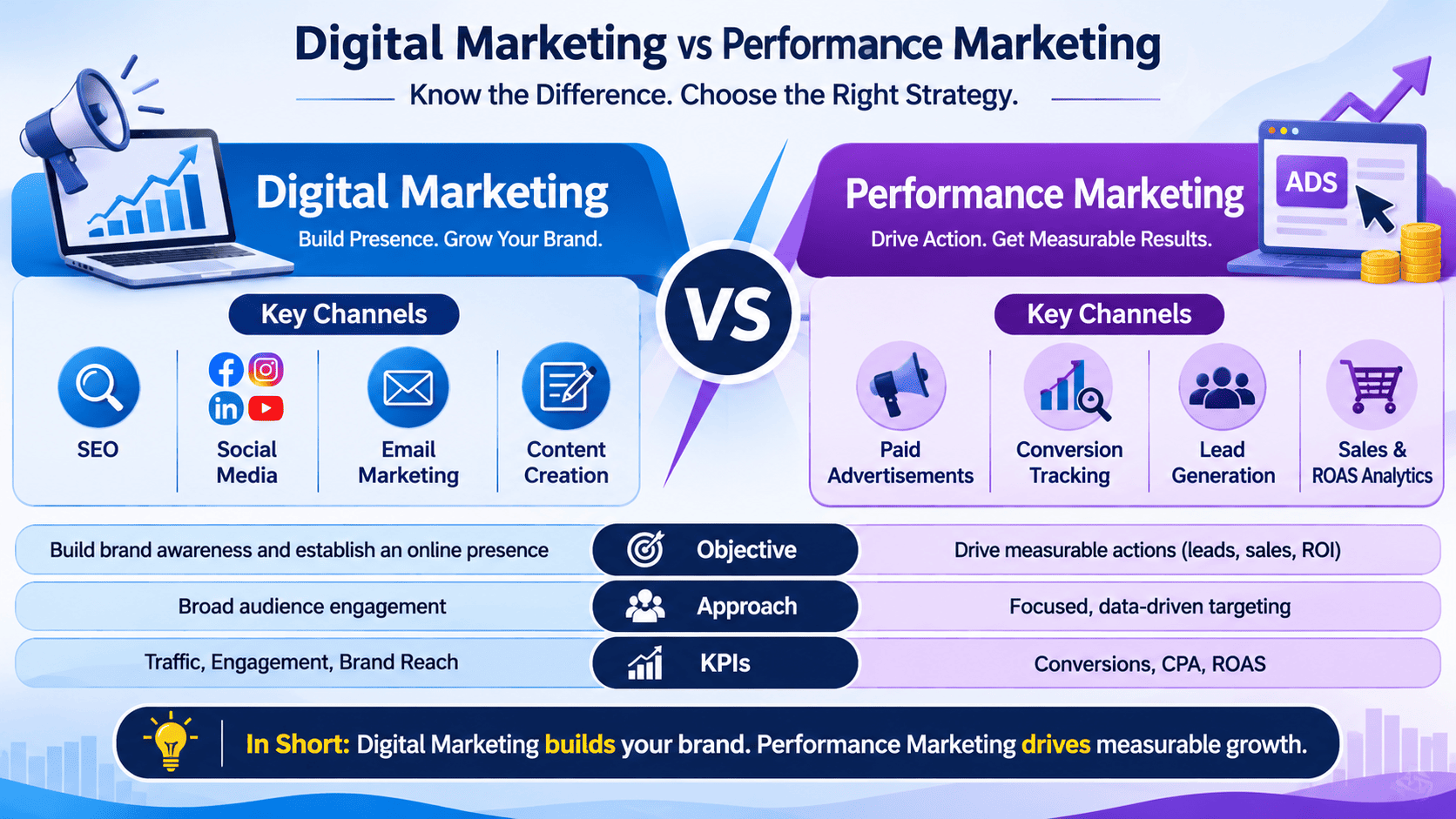
Performance Marketing vs Digital Marketing: Key Differences
Date : 04 Nov, 2026
Performance Marketing Agency Near Me | Grow Your Business
Date : 02 Nov, 2026
How Performance Marketing Helps Small Businesses Grow Fast
Date : 31 Oct, 2026
Best performance marketing agency in Kolkata
Date : 27 Oct, 2026
Performance Marketing Agency in Kolkata | Digital Seeds
Date : 26 Oct, 2026