PAY US SECURELY

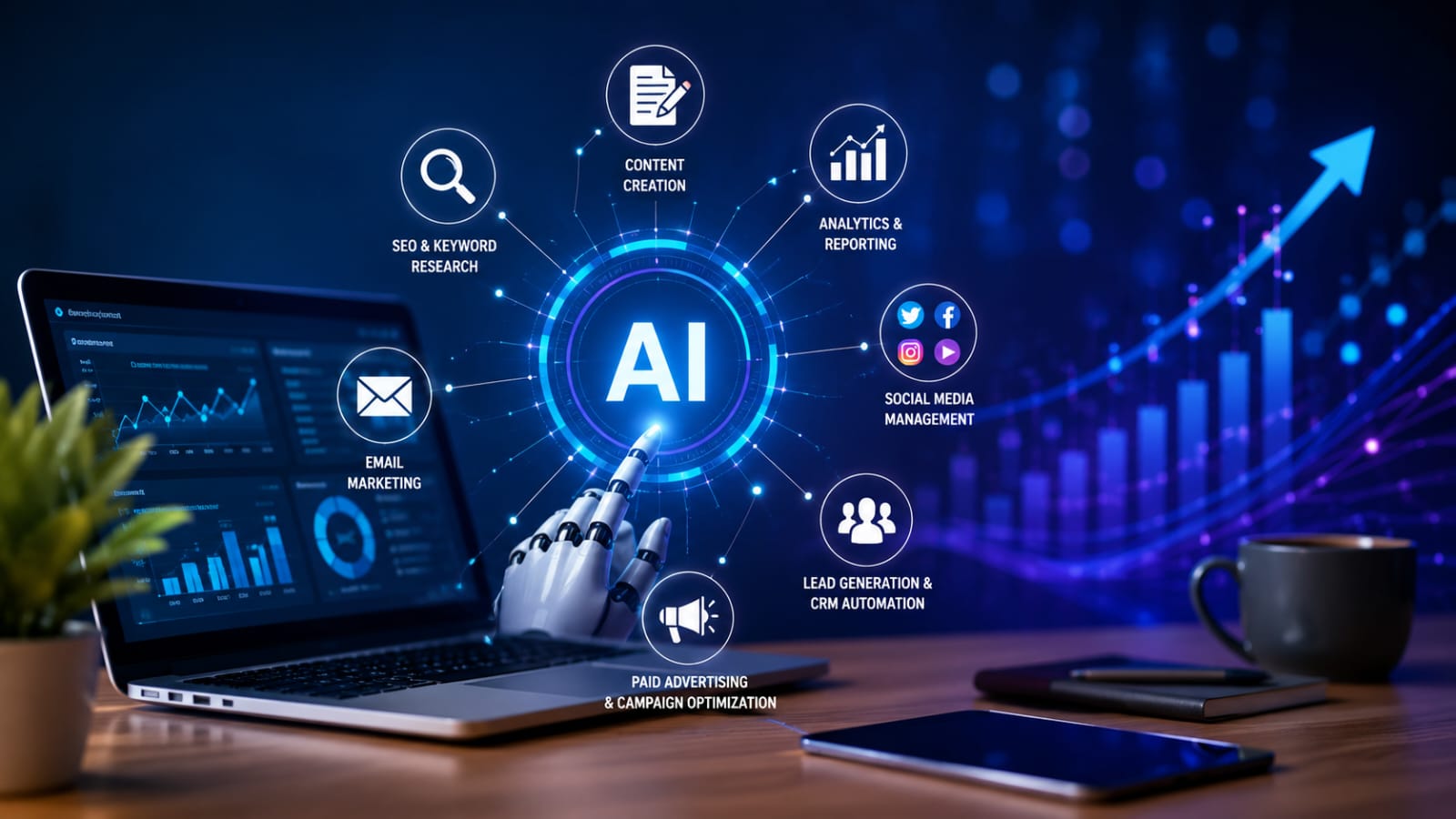
Digital marketing is becoming faster, more competitive and increasingly data-driven. From SEO and content marketing to social media, email campaigns and paid advertising, marketers now have to manage multiple tasks across different platforms.This is where AI tools for digital marketing can make a major difference.
In 2026, AI is no longer limited to generating blog posts or social media captions. Businesses are using AI-powered marketing tools to automate repetitive tasks, analyse customer data, identify content opportunities, optimise campaigns and improve marketing workflows.The goal, however, should not be to automate everything. The smartest approach is to use AI digital marketing automation for repetitive and data-heavy tasks while keeping human creativity, strategy and quality control at the centre of the process.
What Is AI Digital Marketing Automation?
AI digital marketing automation is the use of artificial intelligence, automation platforms and data-driven systems to perform repetitive marketing tasks with less manual effort.Traditional marketing automation focused mainly on activities such as email sequences, lead management and scheduled campaigns. Today, AI marketing automation can support a much wider workflow, including:
- Keyword research
- SEO content planning
- Content creation
- Social media content
- Email marketing
- Lead generation
- Customer segmentation
- Paid advertising
- Competitor analysis
- Marketing analytics
- Performance reporting
Modern AI marketing workflows are increasingly moving from individual AI tasks to connected systems that support research, creation, distribution and analysis.
Why Should Businesses Use AI in Digital Marketing?
One of the biggest advantages of AI marketing automation is efficiency.Instead of spending hours collecting data, creating repetitive content variations or preparing reports, marketers can use AI tools to speed up these processes and spend more time on strategy.
Some major benefits include:
1. Save Time
AI can automate repetitive marketing activities such as content briefs, keyword clustering, social media drafts and reporting.
This allows marketing teams to focus on higher-value activities such as strategy, creativity and customer relationships.
2. Improve Productivity
AI tools can help marketers work across multiple channels without manually performing every small task.
For example, one piece of long-form content can be transformed into social media posts, email content, short-form video ideas and supporting SEO content.
3. Make Better Data-Driven Decisions
AI can analyse large amounts of marketing data much faster than manual analysis.
It can help identify:
- Which campaigns are performing well
- Which keywords are gaining traction
- Which content attracts visitors
- Which audiences are more likely to convert
- Where users are dropping off
4. Scale Content Marketing
Businesses can use AI to accelerate research, content briefs, first drafts, optimisation and content repurposing.
However, AI-generated content should still go through human review because accuracy, originality, brand voice and expertise remain important.
How to Automate Your Digital Marketing Workflow With AI
Now let's look at a practical AI-powered digital marketing workflow.
Step 1: Automate Keyword Research and SEO Planning
SEO is one of the most useful areas for AI automation.
AI SEO tools can help marketers discover keyword opportunities, analyse search intent, group related keywords and identify content gaps.
Instead of manually researching hundreds of keywords, marketers can use AI-assisted SEO platforms to organise keywords according to topics and user intent.
Your workflow can look like this:
Keyword Research → Search Intent → Keyword Clustering → Content Ideas → Content Brief
AI can make the research process faster, but marketers should still validate keyword relevance, competition and business intent before creating content.
Step 2: Use AI for Content Planning
Once you have your keywords, AI can help create a structured content plan.
For example, an AI tool can help generate:
- Blog topics
- H1 and H2 ideas
- FAQs
- Content outlines
- Supporting keywords
- Internal linking opportunities
- Content briefs
This creates a repeatable AI content marketing workflow.
Instead of asking AI to simply “write an article,” give it your target audience, search intent, brand voice, keywords and content objective.
Better inputs generally lead to better outputs.
Step 3: Automate Content Creation
AI writing assistants can help with the first stage of content production.
They can assist with:
- Blog drafts
- Product descriptions
- Social media captions
- Email drafts
- Ad copy
- Video scripts
- Landing page copy
But AI should be treated as a content assistant rather than a complete replacement for marketers.
A strong workflow is:
AI Draft → Human Editing → Fact Checking → SEO Optimisation → Brand Review → Publishing
This approach helps maintain originality, accuracy and brand consistency.
Step 4: Automate Social Media Marketing
Managing multiple social media platforms manually can be time-consuming.
AI-powered social media tools can help marketers create content ideas, generate captions, repurpose existing content and schedule posts.
For example, a single blog post can become:
- LinkedIn posts
- Instagram captions
- Facebook posts
- Short-form video ideas
- Carousel content
- Email content
This is known as content repurposing, and AI can significantly speed up the process.
A simple workflow can be:
Blog → AI Content Repurposing → Social Posts → Scheduling → Performance Analysis
Step 5: Automate Email Marketing
AI can also improve email marketing automation.
Businesses can use AI to assist with:
- Email subject lines
- Personalised content
- Customer segmentation
- Follow-up sequences
- Lead nurturing
- Campaign analysis
Instead of sending the same message to every customer, AI-powered marketing systems can help create more personalised experiences based on customer behaviour and engagement.
Step 6: Use AI for Paid Advertising
Paid advertising generates a huge amount of data.
AI can help marketers analyse campaign performance and create different variations of ad copy and creative concepts.
It can assist with:
- Ad copy variations
- Audience analysis
- Creative testing
- Campaign optimisation
- Performance analysis
- Conversion insights
However, marketers should not blindly trust automated recommendations. Campaign goals, budget, audience quality and business profitability still require human judgement.
Step 7: Automate Lead Generation and Follow-Ups
Lead generation is another area where AI automation can save significant time.
AI-powered systems can help identify, categorise and prioritise leads.
For example:
Lead Captured → Lead Qualification → Lead Scoring → Automated Follow-Up → Sales Team
This allows sales teams to spend more time on high-intent prospects instead of manually sorting every lead.
Step 8: Automate Marketing Reports
Reporting is often one of the most repetitive tasks for digital marketing teams.
Instead of manually collecting data from different platforms, marketers can build automated reporting workflows.
AI can help analyse:
- Website traffic
- Organic search performance
- Social media engagement
- Ad performance
- Leads
- Conversions
- Customer acquisition
- ROI
The important part is not simply generating a report. AI should help transform raw data into actionable marketing insights.
Step 9: Optimise for AI Search With AEO and GEO
Digital marketing is also changing because people increasingly use AI platforms for discovery and recommendations.
This means marketers need to think beyond traditional search engine optimisation.
Two important concepts are Answer Engine Optimization (AEO) and Generative Engine Optimization (GEO).
AEO focuses on creating content that directly answers user questions, while GEO focuses on improving the chances of being discovered or referenced in AI-generated answers.
Modern SEO strategies increasingly consider platforms such as Google AI experiences, ChatGPT, Gemini and other AI search systems.
A useful strategy is to create content that is:
- Clear
- Helpful
- Well structured
- Factually accurate
- Easy to understand
- Based on genuine expertise
- Supported by trustworthy sources
The goal should not be to manipulate AI systems. The goal is to create genuinely useful content that deserves to be discovered.
Popular AI Tools for Digital Marketing
The right tool depends on your workflow and business requirements.
Common categories of AI marketing tools include:
AI Content Tools
Useful for brainstorming, drafting, rewriting and content repurposing.
AI SEO Tools
Useful for keyword research, content optimisation, competitor analysis and SEO workflows.
AI Social Media Tools
Useful for content creation, scheduling and social media analysis.
AI Email Marketing Tools
Useful for personalisation, segmentation and automated campaigns.
AI Analytics Tools
Useful for identifying patterns, analysing campaign performance and generating reports.
Workflow Automation Platforms
Platforms such as automation tools can connect different marketing applications and trigger actions automatically.
The key is not to collect dozens of AI tools. Instead, build a simple AI marketing technology stack around the tasks that consume the most time.
Example of an AI-Powered Digital Marketing Workflow
A small business could create a workflow like this:
Step 1: AI finds keyword and content opportunities.
Step 2: AI creates a content brief.
Step 3: Marketer reviews the strategy.
Step 4: AI creates the first content draft.
Step 5: Human editor checks facts, expertise and brand voice.
Step 6: SEO optimisation is completed.
Step 7: Content is published.
Step 8: AI repurposes the content for social media and email.
Step 9: Posts are scheduled automatically.
Step 10: Analytics are collected automatically.
Step 11: AI identifies performance trends.
Step 12: Marketer uses those insights to improve the next campaign.
This creates a continuous marketing loop:
Research → Create → Publish → Promote → Analyse → Optimise → Repeat
Common Mistakes to Avoid With AI Marketing Automation
AI automation can be powerful, but using it incorrectly can create more problems than it solves.
1. Automating Everything
Not every marketing task should be automated.
Strategy, positioning, creative direction and important customer communication require human judgement.
2. Publishing Unedited AI Content
AI-generated content can contain inaccurate information, generic language or unsupported claims.
Always review important content before publishing.
3. Using Too Many Tools
Buying multiple tools without a clear workflow can increase complexity and costs.
Start with one problem and choose the tool that solves it.
4. Ignoring Brand Voice
AI-generated content can sound generic if it is not guided properly.
Create clear brand guidelines covering tone, vocabulary, messaging and audience.
5. Focusing Only on Productivity
Saving time is useful, but the ultimate goal of digital marketing is business growth.
Measure AI automation against meaningful KPIs such as leads, conversions, revenue, customer acquisition cost and ROI.
The Future of AI-Powered Digital Marketing
The future of digital marketing is moving from simple AI assistance toward more connected and automated workflows.
Instead of using AI only to generate a caption or blog draft, businesses are increasingly connecting AI with SEO data, analytics, CRM systems, advertising platforms and content workflows.
This means the modern marketer's role is gradually shifting from doing every repetitive task manually to designing, managing and optimising intelligent marketing systems.
At the same time, human creativity and judgement remain essential. AI can accelerate execution, but businesses still need strong positioning, authentic messaging, original ideas and a deep understanding of their customers.
Conclusion
AI tools for digital marketing are changing how businesses research, create, distribute and measure marketing campaigns.
From AI SEO and content automation to social media marketing, email automation, paid advertising and analytics, AI can reduce repetitive work and help marketing teams operate more efficiently.
But successful AI marketing is not about replacing humans.
It is about combining Artificial Intelligence + Automation + Human Creativity + Marketing Strategy.
Businesses that build smart, measurable and human-supervised AI marketing workflows can save time, improve productivity and create a more scalable digital marketing system.
The best time to start is not by automating everything at once. Start with one repetitive marketing task, measure the result, improve the workflow and gradually expand your AI-powered marketing system.

Best Digital Marketing Agency in Kolkata | Expert Guide
Date : 18 Sep, 2026
Why Your Business Needs WhatsApp Marketing in 2026
Date : 15 Sep, 2026
How Social Media Marketing Helps Businesses Grow
Date : 10 Sep, 2026
How Social Media Marketing Helps Businesses Grow
Date : 08 Sep, 2026
How to Use AI Tools to Automate Your Digital Marketing Workflow in 2026
Date : 01 Sep, 2026
GEO vs SEO: What’s the Future of Search Optimization?
Date : 24 Aug, 2026