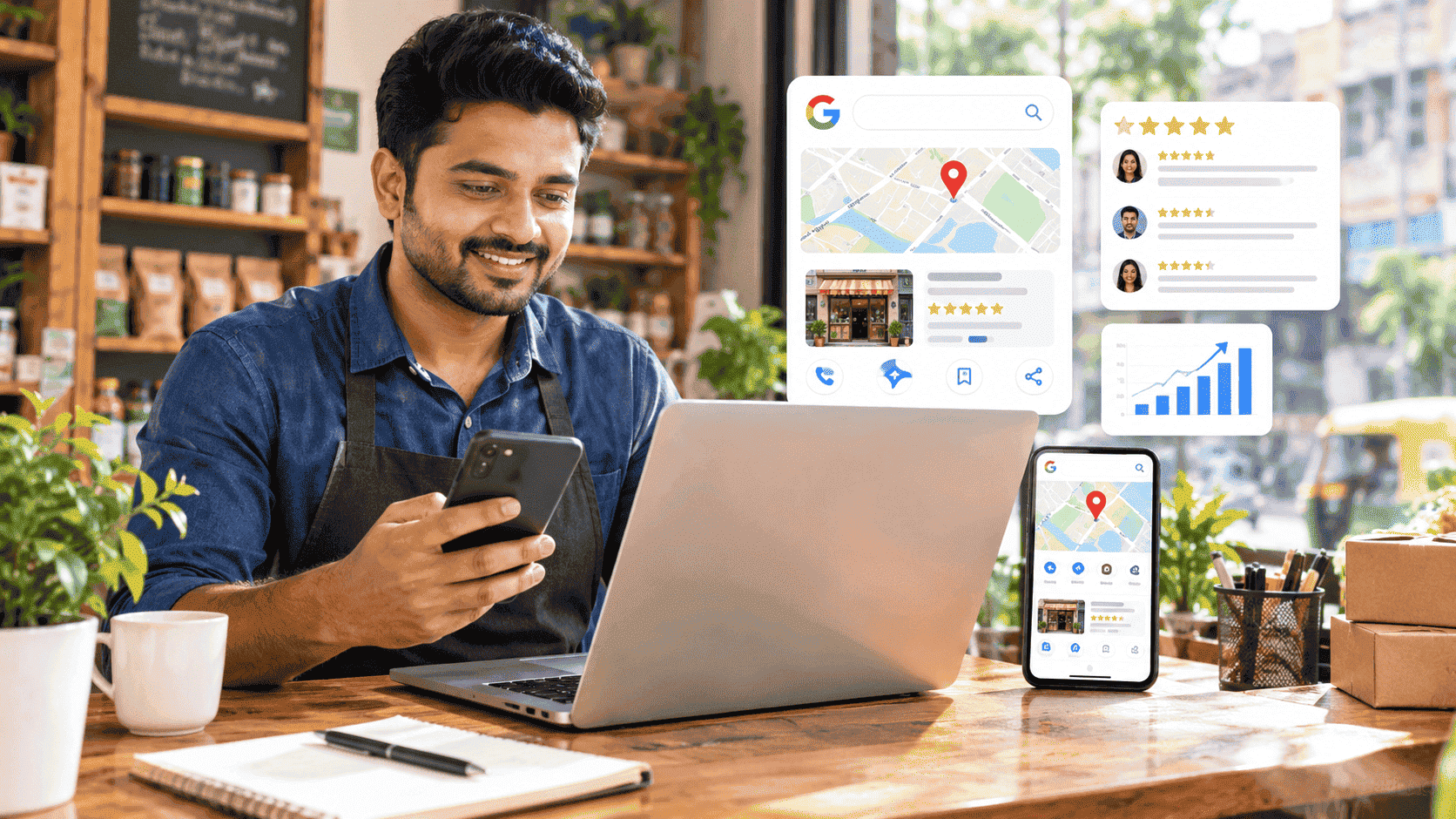
Local SEO Tips for Small Business Owners | 2026 Guide
Date : 03 Oct, 2026
Local SEO Tips for Small Business Owners
For a small business, being visible to customers in your local area can be more valuable than receiving thousands of visitors from locations you do not serve.
When someone searches for “restaurant near me,” “plumber in Kolkata,” “digital marketing agency near me,” “dentist in Salt Lake,” or another location-specific service, Google attempts to show businesses that are relevant to that search and nearby.
This is where local SEO for small businesses becomes important.
Local SEO is the process of improving your online presence so potential customers can discover your business through Google Search, Google Maps and other local search experiences.
After working on local search strategies, Google Business Profiles, websites, reviews and location-based content, one thing becomes very clear: most small businesses do not need complicated SEO tricks first. They need to get the fundamentals right and maintain them consistently.
Google says local results are primarily influenced by relevance, distance and prominence, and businesses can improve their visibility by keeping their Business Profile complete and accurate, responding to reviews and adding useful photos and videos.
What Is Local SEO?
Local SEO is a specialized part of search engine optimization focused on attracting customers from a specific geographic area.
Traditional SEO may target a broad search such as:
Google uses business information and other signals to understand which local businesses may be relevant. Business Profile information can also come from public web content, third-party data, user contributions and business owners themselves.
For a small business, this means your website and Google Business Profile should tell a consistent and useful story about:
Who you are + what you offer + where you serve + why customers should trust you.
Why Local SEO Is Important for Small Businesses
Large brands can spend enormous amounts on advertising and brand awareness. Small businesses often have a different advantage: they can be highly relevant to customers in a specific location.
The value of local SEO is therefore not simply rankings.
The real objective is to increase qualified local actions.
For example, ranking for a highly relevant local keyword that produces five genuine enquiries can be more useful to a small business than ranking for a broad keyword that brings hundreds of irrelevant visitors.
Claim and Verify Your Google Business Profile
One of the first things every eligible local business should do is claim and verify its Google Business Profile.
Verification helps establish that you are authorized to represent the business. Google also recommends keeping business information complete and accurate.
Your profile should accurately represent the business as it exists in the real world.
Do not create a profile simply to manipulate local rankings. Your business information should reflect your real-world business. Google specifically advises businesses to represent themselves consistently and accurately.
Choose the Most Relevant Primary Category
Your Google Business Profile category helps Google understand what your business is.
This is an area where small businesses often make an avoidable mistake: selecting categories simply because they contain desirable keywords.
Google advises businesses to choose relevant categories rather than using categories solely as keywords.
For example, a business should not select an unrelated category just because it believes that category has more search volume.
Think from the customer's perspective:
“What is the main thing this business actually is?”
That should guide the primary category selection.
Relevant secondary categories can be added where appropriate, but every category should accurately describe the business.
Complete Every Important Section of Your Business Profile
A partially completed profile can create an incomplete customer experience.
Provide as much accurate business information as Google allows.
Google's guidelines say the description should provide useful information about the services and products offered, as well as relevant details about the business, while avoiding irrelevant or promotional content.
A natural description is better for users than something like:
“Best #1 top cheap best service company in Kolkata Kolkata Kolkata.”
Keyword repetition does not replace useful information.
Target Local Keywords Based on Search Intent
One of the most important local SEO tips for small business owners is to stop thinking only about search volume.
Each location page should contain genuinely useful, location-specific information.
Google's broader search guidance emphasizes creating helpful, reliable, people-first content rather than content created mainly to manipulate search rankings.
Keep Your Business Information Consistent
Your business name, address and contact details should be consistent across your website and important online business listings.
This helps customers and search engines understand that different references belong to the same business.
Check your information across:
Website
Google Business Profile
Social media profiles
Business directories
Industry directories
Review platforms
Pay particular attention after moving offices, changing phone numbers or rebranding.
For service-area businesses, make sure your stated service areas also reflect where you genuinely operate. Google provides service-area fields for businesses that travel to customers.
Build a Real Review Generation Process
Reviews are extremely important for local businesses because they influence customer trust and contribute to Google's local search signals.
Google states that review quantity and positive ratings can contribute to local ranking, while responding to reviews can help businesses stand out and demonstrate that they value customer feedback.
The important word here is real.
Do not buy fake reviews or create reviews yourself.
Instead, build a simple process:
Complete the service → Ask the genuine customer for feedback → Give them the correct review link → Respond professionally.
You should also respond to negative reviews calmly.
A negative review does not necessarily need an aggressive response. A professional answer can acknowledge the experience, clarify the situation where appropriate and invite the customer to resolve the issue privately.
Add Fresh, Genuine Photos
Photos are often underestimated in local SEO.
Think about what a new customer wants to see before contacting you.
Depending on the business, useful images may include:
Exterior signage
Interior
Team members
Products
Completed projects
Service delivery
Before-and-after work where appropriate
Equipment
Events
Customer-facing facilities
Avoid uploading random stock photographs that do not represent your actual business.
Your profile should help a potential customer understand what they are likely to encounter when choosing you.
Publish Regular Google Business Profile Updates
A Google Business Profile should not become something you create once and forget.
Where relevant, publish useful updates about:
New services
Products
Events
Educational information
Completed projects
Seasonal information
Business updates
However, do not treat posting frequency as a magic ranking formula.
The quality and relevance of your business information matter more than blindly publishing low-value posts.
The purpose of a post should be to help customers understand and engage with the business.
Create Content Around Local Customer Problems
Local SEO and content marketing can work together extremely well.
Instead of publishing generic articles, create content based on questions customers in your target market actually ask.
For example, a Kolkata-based home service company might create:
“How to prepare your home for monsoon pest problems in Kolkata”
A local travel business might publish:
“Best time to visit Sikkim from Kolkata”
A digital marketing company might publish:
“How local businesses in Kolkata can improve Google Maps visibility”
This approach gives your website topical depth while making the content useful to people in the target market.
Build Relevant Local Authority
Local visibility is not created entirely inside Google Business Profile.
Google says prominence can be influenced by information about a business across the web, including links, articles and directories, alongside factors such as reviews.
This means relevant local mentions can be valuable.
Consider legitimate opportunities such as:
Local business associations
Industry organizations
Local publications
Community websites
Supplier or partner websites
Local sponsorships
Professional directories
Genuine business citations
The emphasis should be on relevance and authenticity, not buying hundreds of low-quality backlinks.
A small business generally gains more from a handful of meaningful local relationships than from a huge volume of unrelated directory submissions.
Optimize for Mobile Users
A large portion of local searches happen when people are away from a desktop.
That means your website needs to work well on smartphones.
Check:
Page loading speed
Text readability
Button size
Navigation
Contact forms
Click-to-call functionality
WhatsApp/contact options where appropriate
Map and location information
Imagine the user is standing in front of three search results on their phone.
They do not want to fight with a slow website.
They want to know:
What do you offer?
Where are you located?
Are you open?
Can I call you?
Can I book or enquire now?
Good local SEO should make those actions simple.
Track Calls, Forms and Other Local Conversions
This is one of the most important principles I recommend to small business owners.
Do not measure local SEO only through rankings.
Track outcomes.
For example:
Phone calls
Website enquiries
Appointment bookings
Contact-form submissions
WhatsApp conversations
Direction requests
Online purchases
A ranking improvement that produces no commercial value deserves closer investigation.
Likewise, a keyword with modest search volume can be extremely valuable when it consistently generates customers.
Your local SEO dashboard should therefore connect visibility → engagement → enquiries → customers wherever tracking makes that possible.
Monitor Competitors Without Copying Them
Search your main local keywords regularly.
Study what appears in the local results and organic listings.
Look at:
Categories
Services
Reviews
Photos
Website structure
Content
Offers
Customer questions
Areas served
The goal is not to copy competitors.
The goal is to discover gaps.
Maybe competitors have weak service pages. Maybe they do not explain their process. Maybe their photos are outdated. Maybe their websites are difficult to use.
Those gaps can become opportunities for your business.
Do Not Try to Manipulate Your Business Name
This is a particularly important Google Business Profile practice.
Suppose your actual business name is:
ABC Digital Solutions
Do not change it to:
ABC Digital Solutions – Best Digital Marketing Agency in Kolkata – SEO Company
unless that is genuinely the business's real-world name.
Google's guidelines state that the Business Profile name should reflect the business's real-world name, and unnecessary information in the name is not permitted and can lead to profile problems.
Put keywords in appropriate places such as your website content, services and relevant profile information—not by artificially changing the business name.
Use Local SEO and Paid Ads Together When Appropriate
SEO does not have to work in isolation.
A small business may use:
Local SEO for long-term local visibility.
Google Ads for high-intent paid searches.
Meta Ads for audience discovery and remarketing.
Content marketing for education and authority.
Email/WhatsApp follow-up for lead nurturing.
The strongest marketing system is often the one where these channels support each other.
For example, search data from Google Ads can reveal which services generate demand. That information can then help shape SEO content and landing pages.
Common Local SEO Mistakes Small Businesses Should Avoid
Many local SEO problems come from basic implementation mistakes rather than advanced algorithm changes.
Incomplete Business Profile
Missing hours, categories, services or important business information can create a weaker customer experience.
Keyword Stuffing
Repeating the same keyword unnaturally across pages makes content difficult to read and does not replace genuine relevance.
Fake Reviews
Artificial reviews create trust and policy risks.
Duplicate Location Pages
Creating dozens of thin pages with almost identical content is not a substitute for genuine local relevance.
Ignoring Negative Reviews
Silence can make a business appear disengaged.
Inconsistent Information
Old phone numbers or outdated addresses can confuse customers.
Focusing Only on Rankings
A ranking is a measurement, not the final business outcome.
A Simple Local SEO Checklist for Small Business Owners
Use this checklist as a monthly review:
Google Business Profile
Profile verified
Correct primary category
Relevant secondary categories
Accurate hours
Correct phone and website
Accurate address/service area
Services completed
Fresh business photos
Reviews
Genuine review requests
Reviews monitored
Reviews answered professionally
Website
Mobile-friendly
Fast enough to use comfortably
Local service pages
Clear contact options
Accurate business information
Useful local content
Authority
Relevant local listings
Industry mentions
Genuine local links
Consistent business information
Measurement
Calls tracked
Forms tracked
Enquiries monitored
Organic traffic monitored
Local visibility reviewed
How Long Does Local SEO Take?
One of the biggest misconceptions is expecting local SEO to produce dramatic results overnight.
Some improvements can be seen relatively quickly, especially when a profile contains missing or incorrect information. Other improvements take longer because they depend on competition, website authority, content, reviews, local relevance and broader search visibility.
There is also an important limitation: distance matters.
Google explains that local results take the searcher's location into account. A business cannot simply “optimize” its way out of physical distance in every local search.
This is why an honest SEO professional should avoid promising:
“We will guarantee #1 Google Maps ranking everywhere.”
Local search results can vary by searcher's location and query.
Local SEO Tips for Small Business Owners: Expert Takeaway
After years of working with local businesses, I have found that the biggest local SEO gains usually come from getting the fundamentals right before chasing advanced tactics.
A small business should first establish a trustworthy foundation:
Accurate Business Profile → Relevant Categories → Strong Website → Genuine Reviews → Useful Local Content → Consistent Business Information → Measurement → Ongoing Optimization
Local SEO is not simply about putting your city name into every paragraph.
It is about making it easy for Google and customers to understand:
what your business does, where it operates, what makes it relevant, and whether customers can trust it.
Google itself identifies relevance, distance and prominence as the primary factors behind local results.
The businesses that approach local SEO as an ongoing business process—not a one-time listing task—are better positioned to build sustainable local visibility.
Frequently Asked Questions About Local SEO
What is local SEO for small businesses?
Local SEO is the process of improving a business's online presence so it can be discovered by customers searching for relevant products or services in a specific geographic area.
Why is Google Business Profile important for local SEO?
Google Business Profile provides Google with important information about your business and helps customers find businesses across Google Search and Maps. Google recommends keeping profile information complete and accurate.
How can I improve my Google Maps ranking?
Start with accurate and complete business information, a relevant category, genuine customer reviews, useful photos, a strong website and an overall local SEO strategy. Google states that local results are primarily based on relevance, distance and prominence.
How many Google reviews does a small business need?
There is no universal number that guarantees a particular ranking. Focus on consistently earning genuine customer feedback and responding professionally to reviews.
Should I add keywords to my Google Business Profile name?
Only when the words are actually part of your real-world business name. Google says unnecessary information should not be added to the business name.
Is local SEO different from regular SEO?
Yes. Traditional SEO focuses broadly on organic search visibility, while local SEO places additional emphasis on geographic relevance, local business information and local search experiences.
Do small businesses need a website for local SEO?
A Google Business Profile is important, but a well-optimized website can provide additional information about services, locations, expertise and customer experience. It can also support broader organic search visibility.
Can social media improve local SEO?
Social media can support brand visibility, customer engagement and discovery, but it should not be treated as a replacement for core local SEO activities such as accurate business information, a useful website and genuine reviews.
How often should I update my Google Business Profile?
Update information whenever something changes and add useful fresh content where appropriate. Accuracy should take priority over posting simply for the sake of frequency.
Can I guarantee a #1 local ranking?
No legitimate SEO professional can guarantee a #1 local ranking for every search. Google's local results depend partly on relevance, distance and prominence, and the results can vary according to the search and user's location.